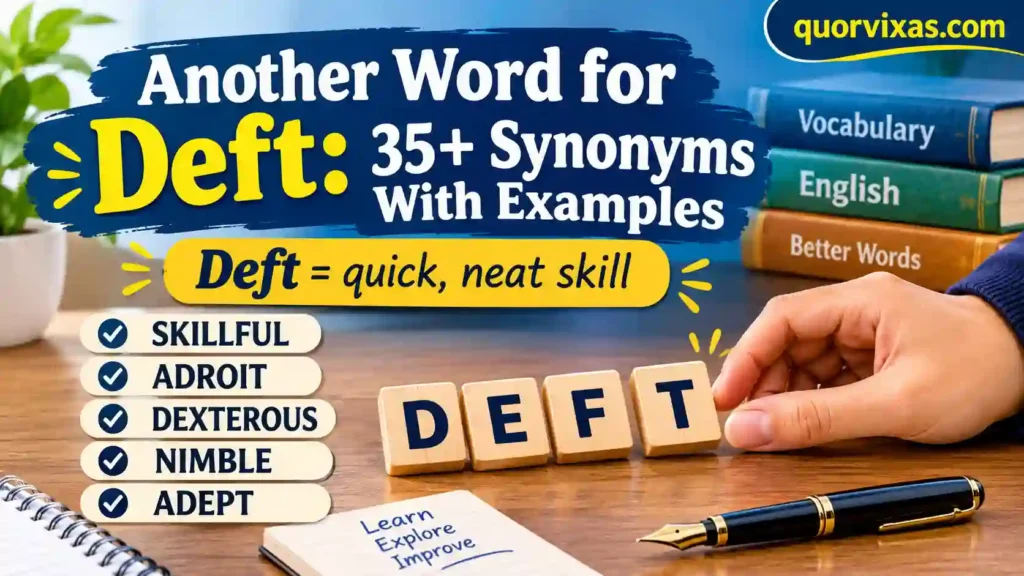
The closest everyday alternatives to deft are skillful, adroit, dexterous, and nimble. All of them describe someone who handles a task, tool, or situation with quick, neat, confident skill. The best choice depends on what you are describing. A pianist’s fingers may be dexterous. A politician’s answer to a tricky question may be adroit.
Deft covers three main areas: physical skill, quick and light movement, and clever handling of people or problems. Some alternatives fit only one of these, so the sections below show where each word works best.
Quick list: skillful, adroit, dexterous, nimble, adept, agile, handy, neat, clever, tactful
This article looks at 35 alternatives, each with its meaning, IPA, usage note, and example. It also covers collocations, word history, common mistakes, and FAQs.
At a Glance: Deft Synonyms and Related Alternatives
| Alternative | Part of Speech | Meaning | Register / Tone | Ideal Context |
| Skillful | Adjective | Having or showing skill | Neutral | General use |
| Adroit | Adjective | Clever and skilled, often under pressure | Formal | Tricky situations, speech, negotiation |
| Dexterous | Adjective | Skilled with the hands or body | Neutral to formal | Crafts, surgery, music |
| Nimble | Adjective | Quick and light in movement | Neutral | Fingers, feet, quick thinking |
| Adept | Adjective | Very good at something | Neutral to formal | Skills and tasks |
| Agile | Adjective | Able to move or think quickly and easily | Neutral | Bodies, teams, minds |
| Handy | Adjective | Skillful at practical tasks | Informal | Repairs, DIY |
| Neat | Adjective | Done in a tidy, careful way | Neutral | Work with clean results |
| Clever | Adjective | Quick to understand or solve | Neutral | Ideas, solutions |
| Tactful | Adjective | Careful not to offend | Neutral | Social situations |
Which Word Should You Use?
| If you want to… | Use | Why |
| Praise skill with the hands | Dexterous | It is the standard word for hand skill. |
| Praise a smooth response to a hard moment | Adroit | It suggests skill under pressure. |
| Describe quick, light movement | Nimble | It stresses speed and lightness. |
| Describe a neat, careful result | Neat | It focuses on the finish of the work. |
| Praise social skill | Tactful | It means handling people without offense. |
| Describe an expert at a task | Adept | It is short and works in most settings. |
| Praise sharp thinking | Astute | It suggests quick, accurate judgment. |
| Sound casual about practical skill | Handy | It is friendly and informal. |
Exploring the Multiple Meanings of “Deft”
1. Skill With the Hands
- Meaning: Quick, neat, and skillful in physical action.
- Explanation: This is the most common sense. Merriam-Webster says deft stresses lightness, neatness, and sureness of touch.
- Example: The surgeon’s deft hands closed the wound in minutes.
2. Quick, Light Movement
- Meaning: Moving easily and smoothly, without wasted effort.
- Explanation: This sense is about the movement itself, not the tool. It often describes athletes, dancers, and drivers.
- Example: With a deft step, she avoided the puddle.
3. Skillful Handling of People or Problems
- Meaning: Showing clever, careful skill in a non-physical task.
- Explanation: This figurative use is common in news and business writing. It describes decisions, speeches, negotiations, and writing.
- Example: The manager’s deft handling of the complaint calmed everyone.
4. Gentle or Meek (Historical)
- Meaning: Mild, gentle, or well-mannered.
- Explanation: This is an older sense, not used in modern English. Dictionary.com traces deft to Old English gedæfte, “mild or gentle.”
- Example: (Historical use only; not a modern example.)
Analyzing 35 Deft Alternatives in Detail
Some of these words are close synonyms of deft, while others fit only one sense and are marked as related alternatives.
Core Skill Synonyms
1. Skillful
IPA: /ˈskɪlfəl/ (US and UK)
Definition: Having or showing ability gained through training or practice.
- Usage: A close, general synonym. It is plainer than deft and does not stress lightness or speed.
- Example: She is a skillful carpenter.
2. Adroit
IPA: /əˈdrɔɪt/ (US and UK)
Definition: Clever and skillful in handling something, often a difficult situation.
- Usage: A close, slightly formal synonym. Merriam-Webster lists it with deft and dexterous. It is often used for quick responses under pressure.
- Example: The lawyer gave an adroit answer to the judge’s question.
3. Dexterous
IPA: /ˈdɛkstərəs/ (US and UK)
Definition: Skillful in using the hands or body.
- Usage: A close synonym for physical skill. It is less natural for abstract skill than adroit.
- Example: The dexterous jeweler set the tiny stone in seconds.
4. Adept
IPA: /əˈdɛpt/ (US and UK)
Definition: Highly skilled at something.
- Usage: A close synonym. It usually appears with at or in and says nothing about lightness of touch.
- Example: He is adept at fixing old radios.
5. Handy
IPA: /ˈhændi/ (US and UK)
Definition: Skillful at doing practical things, especially with the hands.
- Usage: An informal, related alternative. It suggests everyday repair skill, not elegance.
- Example: My uncle is handy with tools.
6. Proficient
IPA: /prəˈfɪʃənt/ (US and UK)
Definition: Having a high degree of skill from training or practice.
- Usage: A related, formal alternative. It suggests competence, not grace.
- Example: She is proficient in three programming languages.
Quick and Light Movement
7. Nimble
IPA: /ˈnɪmbəl/ (US and UK)
Definition: Quick, light, and clever in movement or thought.
- Usage: A close synonym for sense 2. It works for fingers, feet, and minds.
- Example: The nimble climber crossed the rocks without slipping.
8. Agile
IPA: US /ˈædʒəl/ · UK /ˈædʒaɪl/
Definition: Able to move quickly and easily.
- Usage: A related alternative that stresses easy movement. It is also common for flexible teams and quick thinkers.
- Example: The agile goalkeeper reached the ball in time.
9. Quick
IPA: /kwɪk/ (US and UK)
Definition: Done or moving at speed.
- Usage: A related alternative. Deft includes skill and neatness, while quick only means fast.
- Example: She gave a quick, sure reply.
10. Swift
IPA: /swɪft/ (US and UK)
Definition: Moving or acting at great speed.
- Usage: A related, slightly literary alternative. It stresses speed and does not mean skill.
- Example: A swift movement of his hand ended the argument.
11. Lithe
IPA: /laɪð/ (US and UK)
Definition: Bending or moving easily and gracefully.
- Usage: A related alternative for the body. It does not describe skill with tools or people.
- Example: The lithe dancer crossed the stage.
12. Spry
IPA: /spraɪ/ (US and UK)
Definition: Lively and active.
- Usage: A related alternative, often used for older people who move easily. It means energy, not skill.
- Example: He was still spry at ninety.
13. Graceful
IPA: /ˈɡreɪsfəl/ (US and UK)
Definition: Smooth, elegant, and pleasing in movement or form.
- Usage: A related alternative for appearance. A graceful move is not always a skillful one.
- Example: She made a graceful turn on the ice.
Neat and Precise Work
14. Neat
IPA: /niːt/ (US and UK)
Definition: Tidy, careful, and clean in form.
- Usage: A related alternative that focuses on the finished result, not the person’s skill.
- Example: The tailor made a neat repair.
15. Precise
IPA: /prɪˈsaɪs/ (US and UK)
Definition: Exact and accurate in detail.
- Usage: A related alternative. It fits deft when skill shows in exactness.
- Example: The artist used precise strokes.
16. Accurate
IPA: /ˈækjərət/ (US and UK)
Definition: Correct and free from error.
- Usage: A related alternative. It describes the result, not the lightness of the action.
- Example: Her throw was accurate.
17. Practiced
IPA: /ˈpræktɪst/ (US and UK)
Definition: Skilled through repeated practice.
- Usage: A related alternative. It hints that the skill was earned over time. The British spelling is practised.
- Example: He opened the oyster with a practiced twist.
18. Polished
IPA: US /ˈpɑːlɪʃt/ · UK /ˈpɒlɪʃt/
Definition: Refined and skillful, with no rough edges.
- Usage: A related alternative for performances and presentations.
- Example: It was a polished speech.
19. Elegant
IPA: /ˈɛlɪɡənt/ (US and UK)
Definition: Graceful and simple in style or method.
- Usage: A related alternative. It fits solutions and moves that look effortless.
- Example: The team found an elegant fix.
Clever and Mentally Skilled
20. Clever
IPA: US /ˈklɛvər/ · UK /ˈklɛvə/
Definition: Quick to learn, understand, or solve problems.
- Usage: A related alternative for sense 3. It points to intelligence more than smooth handling.
- Example: That was a clever way to save time.
21. Astute
IPA: US /əˈstuːt/ · UK /əˈstjuːt/
Definition: Quick to see what is useful or important.
- Usage: A related, formal alternative that stresses judgment in business, politics, or observation.
- Example: The astute investor spotted the risk early.
22. Shrewd
IPA: /ʃruːd/ (US and UK)
Definition: Sharp and practical in judgment.
- Usage: A related alternative. It can suggest cunning, so it is not always praise.
- Example: She made a shrewd decision.
23. Canny
IPA: /ˈkæni/ (US and UK)
Definition: Careful and smart, especially about money or advantage.
- Usage: A related alternative, a little informal. It suggests street smarts.
- Example: He is a canny negotiator.
24. Savvy
IPA: /ˈsævi/ (US and UK)
Definition: Having practical knowledge and good judgment.
- Usage: A related, informal alternative common in business and tech.
- Example: She is a savvy marketer.
25. Ingenious
IPA: /ɪnˈdʒiːnjəs/ (US and UK)
Definition: Clever, original, and inventive.
- Usage: A related alternative for plans and tools. It stresses invention, not smooth handling.
- Example: They built an ingenious little pulley.
Tactful and Social Skill
26. Tactful
IPA: /ˈtæktfəl/ (US and UK)
Definition: Careful not to upset others.
- Usage: A related alternative. It matches the social side of deft, as in “deft handling” of a delicate talk.
- Example: He was tactful when he gave the bad news.
27. Diplomatic
IPA: /ˌdɪpləˈmætɪk/ (US and UK)
Definition: Skilled at dealing with people without causing offense.
- Usage: A related alternative. It is a good fit for sensitive conversations.
- Example: Her diplomatic reply ended the dispute.
28. Artful
IPA: US /ˈɑːrtfəl/ · UK /ˈɑːtfəl/
Definition: Skillful, sometimes in a clever or sly way.
- Usage: A related alternative. Depending on context it can be praise or hint at trickery.
- Example: She gave an artful answer and avoided the question.
29. Slick
IPA: /slɪk/ (US and UK)
Definition: Smooth and skillful, sometimes in an overly polished way.
- Usage: A related, informal alternative. It can be positive or suggest insincerity.
- Example: It was a slick piece of editing.
Formal and High-Level Skill
30. Masterful
IPA: US /ˈmæstərfəl/ · UK /ˈmɑːstəfəl/
Definition: Showing great skill and control.
- Usage: A strong, related alternative. It is higher praise than deft.
- Example: The pianist gave a masterful performance.
31. Consummate
IPA: US /ˈkɑːnsəmət/ · UK /ˈkɒnsəmət/
Definition: Complete or perfect in skill.
- Usage: A formal, related alternative. It suggests the highest level of skill.
- Example: He is a consummate professional.
32. Accomplished
IPA: US /əˈkɑːmplɪʃt/ · UK /əˈkʌmplɪʃt/
Definition: Highly skilled through training or experience.
- Usage: A related, formal alternative that describes people more than single actions.
- Example: She is an accomplished violinist.
33. Expert
IPA: US /ˈɛkspɜːrt/ · UK /ˈɛkspɜːt/
Definition: Having special skill or knowledge from experience.
- Usage: A related alternative. It is about knowledge and experience, not lightness of touch.
- Example: He gave expert advice on bridge repair.
34. Able
IPA: /ˈeɪbəl/ (US and UK)
Definition: Having the skill or power to do something.
- Usage: A weak, related alternative. It is plain and does not carry the style of deft.
- Example: She is an able leader.
35. Capable
IPA: /ˈkeɪpəbəl/ (US and UK)
Definition: Having the ability needed for a task.
- Usage: A weak, related alternative. It means competent, not neat or quick.
- Example: He is a capable mechanic.
Deft vs. Adroit vs. Dexterous
These three are close, and Merriam-Webster groups them as words for skill in physical movement.
| Word | Main Focus | Best Use |
| Deft | Lightness, neatness, sureness of touch | A smooth, careful action |
| Adroit | Cleverness in handling a situation | Quick responses, tricky moments |
| Dexterous | Skill with the hands | Crafts, surgery, music |
If you want only one word for most situations, deft is a safe choice.
Deft and Opposite/Paired Word Pairs
| Word | Paired Word | Note |
| Deft | Clumsy | The most common opposite. |
| Deft | Awkward | Stiff and uncomfortable in movement or manner. |
| Deft | Inept | Lacking skill or ability. |
| Deft | Maladroit | The formal opposite of adroit. |
| Deft | Bungling | Informal, for badly handled work. |
Most of these pairs contrast skill with lack of skill. Deft belongs in the table because the two words share an origin, even though their modern meanings differ.
Common Word Partners of “Deft”
| Pattern | Common Partners | Example |
| deft + body part | hands, fingers, touch | She worked with deft fingers. |
| deft + action | handling, maneuver, move | The driver made a deft maneuver. |
| deft + use/skill | use of, hand at | The photographer made deft use of light. |
| deft + blend/mix | blend, combination | The film is a deft blend of comedy and drama. |
| deftly + verb | handled, avoided, sidestepped | He deftly avoided the question. |
Idiomatic Phrases Featuring “Deft”
Deft has no true idioms. The expressions below are established phrases that appear often in print.
1. A deft hand (at something)
- Meaning: A skillful way of handling a task or problem.
- Example: The coach showed a deft hand in managing the team’s mood.
2. A deft touch
- Meaning: A light, skillful, careful way of doing something.
- Example: The editor’s deft touch improved the story without changing its voice.
3. Deft footwork
- Meaning: Skillful handling of a situation, borrowed from the literal footwork of sport and dance.
- Example: The mayor’s deft footwork avoided a public fight.
Word Formation of “Deft”
Etymology & Structure
Deft is a short, single-syllable adjective. Merriam-Webster says it perhaps continues Middle English daffte or defte, meaning “well-mannered, gentle, dull, foolish.” Dictionary.com calls it a variant of reckless and traces it to Old English gedæfte, “mild or gentle.” Anatoly Liberman writes deft share a starting point meaning “fitting, convenient.”
Date and History
Dictionary.com records deft in Middle English in 1175–1225. Merriam-Webster dates its first known use to the 15th century. Etymonline dates the adverb deftly to the mid-15th century. An earlier adverb, daftelike, meant “mannerly, properly, modestly, humbly” around 1200.
Word Class Variations
- Adjective: deft (comparative defter, superlative deftest)
- Adverb: deftly
- Noun: deftness
Deft has no standard verb form.
Sources: Merriam-Webster; Dictionary.com; Etymonline; OUPblog.
Common Word-Choice Mistakes
- “She moved deft”: use deftly when describing a verb.
- “He made a deft mistake”: use clumsy or careless, because deftness is positive.
- “She is deftful”: deftful is not a word. Say deft.
- “A deft weightlifter”: use powerful or strong, since deft is about skill, not strength.
- “A deft but sloppy repair”: use quick but sloppy, since deft implies neatness.
- “A spry young athlete”: spry often describes older people, so use agile or nimble.
Frequently Asked Questions
What is the closest synonym for deft?
Adroit and dexterous are the closest. Skillful is the simplest everyday choice.
What is another word for deft in a formal setting?
Adroit, consummate, and accomplished formal writing.
Is deft the same as clever?
Not exactly. Clever stresses intelligence, while deft stresses smooth, skillful handling.
What is the opposite of deft?
The usual opposites are clumsy, awkward, and inept.
Can deft describe a person?
Yes, though it is more common for hands, actions, or handling, as in “a deft negotiator.”
Can deft describe thinking or speech?
Yes. Writers use it for deft answers, edits, and decisions.
What is the difference between deft and dexterous?
Dexterous usually points to skill with the hands. Deft can also describe light, clever handling of non-physical tasks.
Is deft a positive word?
Yes. It is a compliment about skill and neatness.
What is the adverb form of deft?
Deftly, as in “She deftly caught the cup.”
Conclusion
The closest alternatives to deft are skillful, adroit, dexterous, nimble, and adept. These words describe quick, neat skill in action, and each leans toward a slightly different area.
Context decides the best choice. Use dexterous for hand skill, nimble for quick movement, adroit for clever handling of hard moments, and tactful for social skill.
To choose well, first ask what kind of skill you mean: physical, mental, or social. Then pick the word that fits that area, and use deft when you want to stress lightness and sureness of touch.

Hi, I’m Alex Morgan! I love exploring words and discovering new ways to express ideas. Through Quorvixas.com, I’m here to help you find the right synonyms, expand your vocabulary, and make writing feel easier, more natural, and enjoyable.