
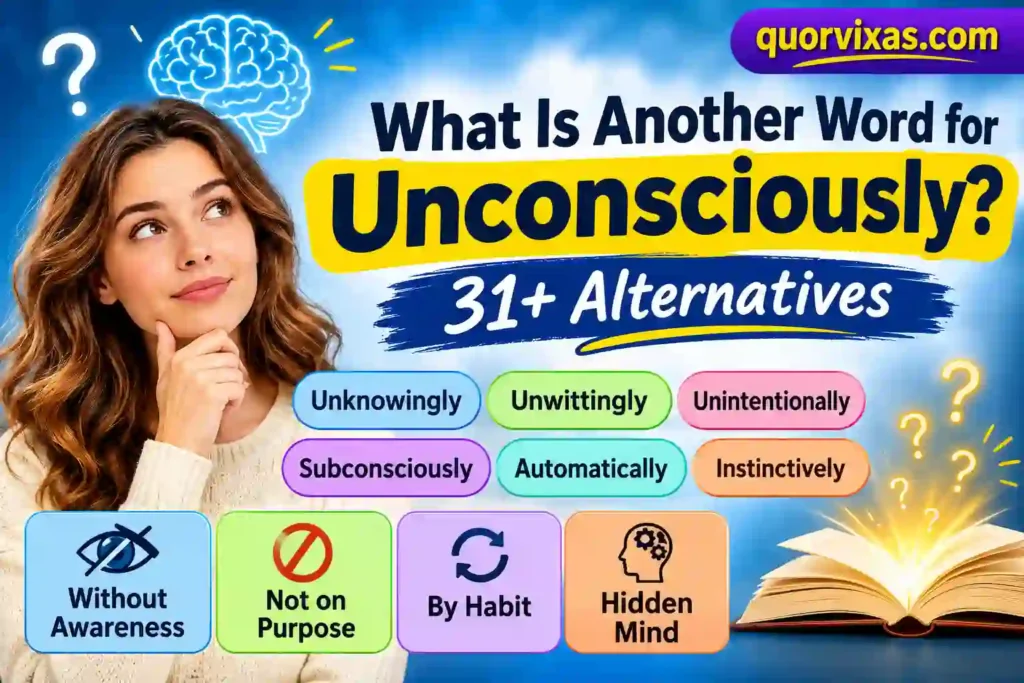
The closest everyday alternatives to unconsciously are unknowingly, unwittingly, unintentionally, and subconsciously. All of them describe something done without full awareness or without planning it. The best choice depends on what you mean. Did the person fail to notice, act by habit, make a mistake, or act on a hidden mental drive?
“Unconsciously” covers several ideas: not realizing, not meaning to, acting automatically, and acting from the mind’s hidden layers. Each idea has its own set of better-fitting words.
Quick list: unknowingly, unwittingly, unintentionally, inadvertently, subconsciously, automatically, instinctively, absentmindedly, obliviously, involuntarily
This article looks at 31 alternatives, with meanings, IPA, usage notes, examples, and context.
At a Glance: Unconsciously Synonyms and Related Alternatives
| Alternative | Part of Speech | Meaning | Register / Tone | Ideal Context |
| Unknowingly | Adverb | Without knowing | Neutral | Everyday facts you did not know |
| Unwittingly | Adverb | Without knowing, often with a result | Neutral to formal | Playing a part in something |
| Unintentionally | Adverb | Not on purpose | Neutral | Everyday mistakes |
| Inadvertently | Adverb | Through lack of attention | Formal | Reports, apologies |
| Subconsciously | Adverb | Below conscious awareness | Neutral | Hidden motives, habits |
| Automatically | Adverb | Without thinking, by habit | Neutral | Routine actions |
| Instinctively | Adverb | By natural impulse | Neutral | Quick reactions |
| Absentmindedly | Adverb | While thinking of something else | Informal | Small distracted acts |
| Obliviously | Adverb | Completely unaware | Neutral | Missing something obvious |
| Involuntarily | Adverb | Without control | Neutral to formal | Body reactions |
Which Word Should You Use?
| If you want to… | Use | Why |
| Say you did not know a fact | Unknowingly | It focuses on missing knowledge. |
| Show you played a part in something | Unwittingly | It often points to a result you did not expect. |
| Describe a harmless mistake | Unintentionally | It simply means “not on purpose.” |
| Sound formal in writing | Inadvertently | It suits reports and official language. |
| Talk about hidden mental drives | Subconsciously | It suggests the mind below awareness. |
| Describe a habit | Automatically | It stresses acting without thinking. |
| Describe a body reaction | Involuntarily | It means you could not control it. |
| Describe someone missing the obvious | Obliviously | It adds a note of blindness or mild humor. |
Exploring the Multiple Meanings of “Unconsciously”
1. Without Awareness
- Meaning: Without realizing or noticing.
- Explanation: This is the most common sense. The person does not know what they are doing or what is happening.
- Example: She unconsciously hummed the tune all morning.
2. Without Intention
- Meaning: Not on purpose.
- Explanation: Here the focus is on the lack of planning, not the lack of knowledge. It is close to “accidentally.”
- Example: He unconsciously copied his boss’s way of speaking.
3. Automatically or by Habit
- Meaning: Without thought, as a routine action.
- Explanation: The action is so familiar that the mind barely takes part.
- Example: She unconsciously reached for her phone every few minutes.
4. From the Hidden Mind
- Meaning: Driven by mental processes a person is not aware of.
- Explanation: This is the psychological sense. It is used for hidden beliefs, fears, or biases that shape behavior.
- Example: Many people are unconsciously influenced by first impressions.
Note: The adjective “unconscious” also means “knocked out” or “not awake.” The adverb is rarely used in that sense. People usually say “fell unconscious.”
Analyzing 31 Unconsciously Alternatives in Detail
Some alternatives below are direct synonyms, while others fit only one sense or context. Related alternatives are labeled as such.
Core Synonyms
1. Unknowingly
IPA: US /ʌnˈnoʊɪŋli/ · UK /ʌnˈnəʊɪŋli/
Definition: Without knowing something.
- Usage: A direct synonym for the “without awareness” sense. It is neutral and very common.
- Example: He unknowingly walked into a private meeting.
2. Unwittingly
IPA: /ʌnˈwɪtɪŋli/ (US and UK)
Definition: Without being aware of the facts or the effect of an action.
- Usage: A direct synonym, slightly more formal. It often suggests you caused or joined in something without knowing.
- Example: She unwittingly helped spread the rumor.
3. Unintentionally
IPA: /ˌʌnɪnˈtenʃənəli/ (US and UK)
Definition: Without planning or meaning to.
- Usage: A direct synonym for the “without intention” sense. It does not say if the person knew what they were doing.
- Example: I unintentionally deleted the file.
4. Inadvertently
IPA: US /ˌɪnədˈvɜːrtəntli/ · UK /ˌɪnədˈvɜːtəntli/
Definition: As a result of not paying enough attention.
- Usage: A formal synonym for errors and slips. It is common in reports and apologies.
- Example: The email was inadvertently sent to the wrong team.
5. Subconsciously
IPA: US /ˌsʌbˈkɑːnʃəsli/ · UK /ˌsʌbˈkɒnʃəsli/
Definition: In a way that is influenced by the mind without the person noticing.
- Usage: Often interchangeable with “unconsciously” in everyday speech. It suggests something hidden just beneath awareness.
- Example: He subconsciously avoided the topic.
6. Accidentally
IPA: /ˌæksɪˈdentəli/ (US and UK)
Definition: By chance or by mistake.
- Usage: A close synonym for the “not on purpose” sense only. It does not suggest hidden motives or habits.
- Example: She accidentally left her keys at home.
7. Involuntarily
IPA: US /ɪnˈvɑːlənˌterəli/ · UK /ɪnˈvɒləntrəli/
Definition: Without choice or control.
- Usage: A related alternative. It fits body reactions, not mistakes or awareness.
- Example: He involuntarily flinched at the noise.
8. Unawares
IPA: US /ˌʌnəˈwerz/ · UK /ˌʌnəˈweəz/
Definition: Without being aware, or by surprise.
- Usage: A direct synonym, though older in tone. It often appears in “catch someone unawares.”
- Example: The question caught him unawares.
Automatic and Habitual Alternatives
9. Automatically
IPA: /ˌɔːtəˈmætɪkli/ (US and UK)
Definition: Without conscious thought, as if by habit.
- Usage: A related alternative for the “habit” sense. It does not suggest hidden motives.
- Example: She automatically checked the lock before leaving.
10. Instinctively
IPA: /ɪnˈstɪŋktɪvli/ (US and UK)
Definition: In a way that comes from natural feeling, not thought.
- Usage: A related alternative for fast reactions. It suggests something natural or built-in.
- Example: He instinctively stepped back from the edge.
11. Reflexively
IPA: /rɪˈfleksɪvli/ (US and UK)
Definition: In a quick, automatic way, as a reflex.
- Usage: A related alternative. It is stronger and more physical than “automatically.”
- Example: She reflexively covered her face.
12. Mechanically
IPA: /məˈkænɪkli/ (US and UK)
Definition: In a routine way, without thought or feeling.
- Usage: A related alternative. It can sound critical, like acting without interest.
- Example: He mechanically answered each email.
13. Habitually
IPA: /həˈbɪtʃuəli/ (US and UK)
Definition: As a regular habit.
- Usage: A related alternative. It stresses repetition, not lack of awareness.
- Example: She habitually sat in the same seat.
14. Intuitively
IPA: US /ɪnˈtuːɪtɪvli/ · UK /ɪnˈtjuːɪtɪvli/
Definition: By feeling or sense, without reasoning.
- Usage: A related alternative. It suggests a useful inner sense, not a mistake.
- Example: She intuitively knew something was wrong.
Without Thought or Attention
15. Unthinkingly
IPA: /ʌnˈθɪŋkɪŋli/ (US and UK)
Definition: Without careful thought.
- Usage: A close synonym. It suggests a quick act that was not considered.
- Example: He unthinkingly repeated the secret.
16. Absentmindedly
IPA: /ˌæbsəntˈmaɪndɪdli/ (US and UK)
Definition: In a way that shows the mind is on something else.
- Usage: A related alternative. It fits small, distracted actions.
- Example: She absentmindedly stirred her tea for minutes.
17. Mindlessly
IPA: /ˈmaɪndləsli/ (US and UK)
Definition: Without using thought or attention.
- Usage: A related alternative. It can sound negative or even harsh.
- Example: They mindlessly scrolled through videos.
18. Inattentively
IPA: /ˌɪnəˈtentɪvli/ (US and UK)
Definition: Without paying proper attention.
- Usage: A related, formal alternative. It points to a lack of focus.
- Example: He listened inattentively and missed the details.
19. Heedlessly
IPA: /ˈhiːdləsli/ (US and UK)
Definition: Without caring about warnings or risks.
- Usage: A related alternative. It adds a note of carelessness, so it is stronger than “unconsciously.”
- Example: She heedlessly crossed the busy road.
20. Carelessly
IPA: US /ˈkerləsli/ · UK /ˈkeələsli/
Definition: Without enough care or attention.
- Usage: A related alternative. It criticizes the action, which “unconsciously” usually does not.
- Example: He carelessly left the door open.
Unaware or Caught Off Guard
21. Unsuspectingly
IPA: /ˌʌnsəˈspektɪŋli/ (US and UK)
Definition: Without suspecting danger or a trick.
- Usage: A context-specific alternative. It suits traps, surprises, and stories.
- Example: The visitors unsuspectingly stepped into the trap.
22. Obliviously
IPA: /əˈblɪviəsli/ (US and UK)
Definition: In a way that shows complete unawareness of what is around you.
- Usage: A close synonym for “without awareness,” often with humor or mild criticism.
- Example: He chatted on, obliviously, while everyone waited.
23. Blindly
IPA: /ˈblaɪndli/ (US and UK)
Definition: Without seeing, understanding, or questioning.
- Usage: A figurative, related alternative. It suggests following without thought or knowledge.
- Example: They blindly followed the old rules.
Formal and Gradual Alternatives
24. Imperceptibly
IPA: US /ˌɪmpərˈseptəbli/ · UK /ˌɪmpəˈseptəbli/
Definition: In a way too slight to notice.
- Usage: A related alternative. It fits slow changes, not human choices.
- Example: His accent shifted imperceptibly over the years.
25. Insensibly
IPA: /ɪnˈsensəbli/ (US and UK)
Definition: So gradually that it is not noticed.
- Usage: A formal, somewhat literary alternative. Do not confuse it with “insensitively.”
- Example: Winter slid insensibly into spring.
26. Unmindfully
IPA: /ʌnˈmaɪndfəli/ (US and UK)
Definition: Without paying attention or care.
- Usage: A rare, formal alternative. It is close to “inattentive.”
- Example: She unmindfully stepped on the flowers.
Psychological and Inner-Driven Alternatives
27. Subliminally
IPA: /sʌbˈlɪmɪnəli/ (US and UK)
Definition: In a way that affects the mind without being consciously noticed.
- Usage: A related alternative. It is mainly used for messages or signals, such as ads, not personal habits.
- Example: The music subliminally set the mood.
28. Innately
IPA: /ɪˈneɪtli/ (US and UK)
Definition: In a way that is present from birth.
- Usage: A related alternative. It points to natural traits, not unaware actions.
- Example: Babies innately respond to faces.
29. Viscerally
IPA: /ˈvɪsərəli/ (US and UK)
Definition: In a deep, gut-level way, without reasoning.
- Usage: A figurative, related alternative. It fits strong emotional reactions.
- Example: She reacted viscerally to the news.
30. Spontaneously
IPA: US /spɑːnˈteɪniəsli/ · UK /spɒnˈteɪniəsli/
Definition: Without planning or outside cause.
- Usage: A related alternative. It suggests a natural, unplanned act, often a positive one.
- Example: The crowd spontaneously began to sing.
31. Impulsively
IPA: /ɪmˈpʌlsɪvli/ (US and UK)
Definition: Acting suddenly on a feeling, without thinking about results.
- Usage: A related alternative. The person may be fully aware, so it is not an exact synonym.
- Example: He impulsively booked the trip.
Unconsciously vs. Subconsciously vs. Unintentionally
These three words overlap, but each stresses something different.
| Word | Main Idea | Best Used When |
| Unconsciously | Not aware, or driven by the hidden mind | Describing habits, biases, or unnoticed acts |
| Subconsciously | Just below awareness | Describing quiet inner influences |
| Unintentionally | No plan or purpose | Describing mistakes or side effects |
In daily speech, “unconsciously” and “subconsciously” are often swapped. In psychology, some writers prefer “unconscious” as the more standard technical term. “Unintentionally” says nothing about awareness. A person can act unintentionally while fully aware of what they are doing.
Unconsciously and Opposite/Paired Word Pairs
| Word | Paired Word | Note |
| Unconsciously | Consciously | The most natural opposite. |
| Unintentionally | Intentionally | Focuses on purpose. |
| Unknowingly | Knowingly | Focuses on knowledge. |
| Unwittingly | Wittingly | Real but rare. |
| Inadvertently | Deliberately | Contrasts a slip with a choice. |
| Involuntarily | Voluntarily | Contrasts control with choice. |
| Automatically | Deliberately | Contrast habits with planning. |
Many of these pairs are formed with the prefix un- or in-. Others, like “inadvertently” and “deliberately,” are contrasts of meaning, not word-form opposites.
Common Word Partners of “Unconsciously”
| Pattern | Common Partners | Example |
| Verb after the adverb | mimic, copy, absorb, adopt, echo, reveal | Children unconsciously absorb the habits around them. |
| Before an adjective | biased, competent, influenced | The team was unconsciously biased toward older ideas. |
| Paired with consciously | consciously or unconsciously | We all, consciously or unconsciously, judge by looks. |
| Degree words | almost, quite, perhaps, largely | He did it almost unconsciously. |
| Body actions | shake, tap, nod, lean | She unconsciously tapped her foot. |
Idiomatic Phrases Featuring “Unconsciously”
“Unconsciously” has few true idioms. The items below are established expressions, and some use the related form “unconscious.”
1. Unconsciously biased
- Meaning: Holding unfair views without knowing it.
- Example: Even kind managers can be unconsciously biased.
2. Unconsciously competent
- Meaning: Skilled enough to do something without thinking about it. It comes from a well-known model of learning stages.
- Example: After years of driving, she was unconsciously competent behind the wheel.
3. Knocked unconscious
- Meaning: Hit so hard that a person loses consciousness.
- Example: The boxer was knocked unconscious in the third round.
4. The collective unconscious
- Meaning: In Carl Jung’s theory, the shared layer of the unconscious mind that people inherit.
- Example: Jung believed myths came from the collective unconscious.
Word Formation of “Unconsciously”
Etymology & Structure
“Unconsciously” is built from the prefix un- (not), the base conscious, and the ending -ly. The adjective “unconscious” is formed from un- plus conscious, and “unconsciously” is listed as a related form. The base “conscious” comes from the Latin conscius, meaning “knowing” or “aware.”
Date and History
“Unconscious” is recorded from 1712 for “unaware” and “not having consciousness,” while the “knocked out” sense is recorded by 1860. The noun “the unconscious” dates to 1876, and the psychological adjective is recorded from 1912, linked to Freud’s theories.
Word Class Variations
- Adjective: unconscious
- Adverb: unconsciously
- Noun: unconsciousness; the unconscious
- Related base forms: conscious (adjective), consciously (adverb)
There is no standard verb form.
Sources: Etymonline; Merriam-Webster.
Common Word-Choice Mistakes
- She fell unconsciously on the floor: use “She fell unconscious” or “lost consciousness.”
- He unconsciously deleted it to hurt her: use “deliberately” for a purposeful act.
- He unwillingly helped the thief (when he did not know): use “unwittingly.”
- I involuntarily sent it to the wrong person: use “inadvertently” or “accidentally.”
- I subliminally bite my nails: use “unconsciously” or “without thinking.”
- He spoke insensibly about her loss: use “insensitively.”
- She unconsciously, without realizing, smiled: choose one, since the phrases repeat the same idea.
Frequently Asked Questions
What is the closest synonym for unconsciously?
“Unknowingly” is the closest everyday synonym. “Unwittingly” is a good alternative in more formal writing.
Is unconsciously the same as subconsciously?
They overlap in daily speech. “Subconsciously” suggests influences just below awareness, while “unconsciously” is broader.
What is a formal alternative?
“Inadvertently” and “unwittingly” suit formal writing.
What is a literary alternative?
“Insensibly” and “unawares” have a more literary or older tone.
What is the opposite of unconsciously?
“Consciously” is the main opposite. “Deliberately” and “intentionally” work when purpose is the point.
Can unconsciously mean “passed out”?
Not in normal use. People say “fell unconscious” or “lost consciousness.”
What is the difference between unwittingly and unintentionally?
“Unwittingly” means without knowing. “Unintentionally” means without meaning to.
Can I use it unconsciously for people and actions?
Yes. It describes how a person acts, such as “she unconsciously nodded.”
Which word fits a body reaction?
“Involuntarily” and “reflexively” fit best.
Which word fits a habit?
“Automatically” is the clearest choice, and “habitually” works for repeated acts.
Conclusion
The closest alternatives to “unconsciously” are “unknowingly,” “unwittingly,” “unintentionally,” and “subconsciously.” Words like “automatically,” “instinctively,” and “absentmindedly” fit when the action is a habit or a reflex.
Context decides the best word. Missing knowledge calls for “unknowingly.” A mistake calls for “inadvertently,” and a hidden mental drive calls for “subconsciously.” Related words like “impulsively” or “viscerally” describe how something is done, not if a person was aware.
To choose, ask three questions: Did the person know? Did they mean to? Was it a habit or a reaction? Your answers will point to the right word.

Hi, I’m Alex Morgan! I love exploring words and discovering new ways to express ideas. Through Quorvixas.com, I’m here to help you find the right synonyms, expand your vocabulary, and make writing feel easier, more natural, and enjoyable.