
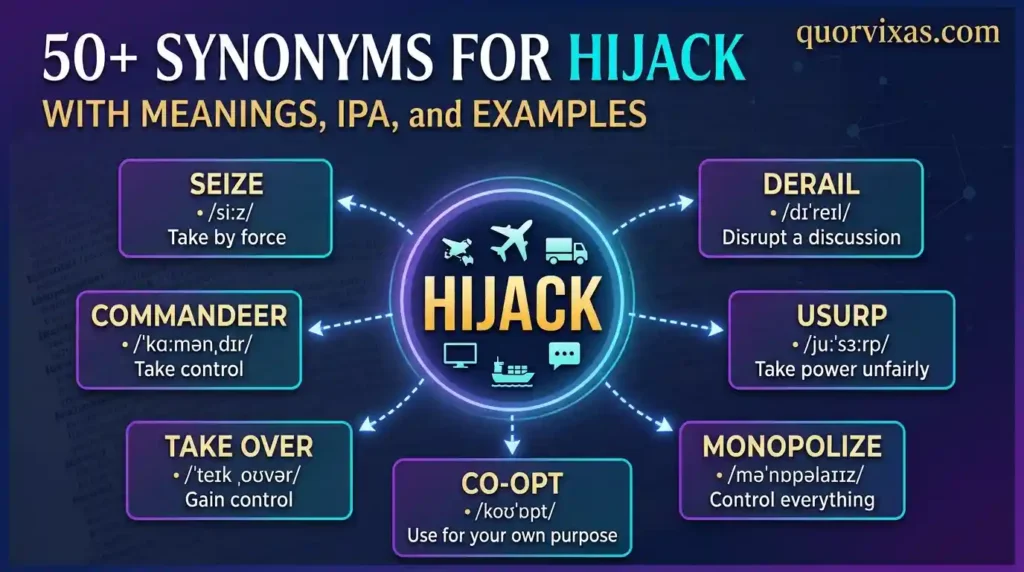
“Hijack” has no single perfect replacement. For a plane, ship, or truck, the closest everyday alternatives are seize, commandeer, and take over. For a conversation, meeting, or idea, co-opt, monopolize, and derail often fit better. The best word depends on what is being taken and how.
Most dictionaries treat “hijack” as seizing a vehicle, or stealing its cargo, by force. It also has figurative uses, such as taking control of a discussion, an account, or someone’s attention.
Quick list: seize, commandeer, take over, skyjack, carjack, steal, usurp, co-opt, monopolize, derail
Below are 30 alternatives with meanings, IPA, usage notes, examples, and context. Some are direct synonyms and some are related words that only fit certain situations.
At a Glance: Hijack Synonyms and Related Alternatives
| Alternative | Part of Speech | Meaning | Register / Tone | Ideal Context |
| Seize | verb | take hold of by force | neutral | vehicles, power, goods |
| Commandeer | verb | take control, often by force or authority | neutral to formal | vehicles, property |
| Take over | phrasal verb | gain control of | neutral | vehicles, systems, meetings |
| Skyjack | verb | hijack an aircraft | informal, dated | aircraft only |
| Carjack | verb | seize a car from its driver | neutral, news style | cars |
| Steal | verb | take without permission | neutral | cargo, goods |
| Usurp | verb | take power or position unlawfully | formal | authority, thrones |
| Co-opt | verb | take over for one’s own purposes | neutral to formal | ideas, movements |
| Monopolize | verb | take all of something | neutral | conversations, attention |
| Derail | verb | disrupt and send off course | neutral | meetings, plans |
Which Word Should You Use?
| If you want to… | Use | Why |
| Describe a plane being taken by force | skyjack or seize | Skyjack is specific, and seize is neutral. |
| Describe a stolen car with the driver present | carjack | It names the exact crime. |
| Describe a truck’s cargo being stolen | steal or rob | The focus is the goods, not the vehicle. |
| Say someone took over a talk unfairly | monopolize or dominate | They describe controlling the talking. |
| Say someone used an idea for their own aims | co-opt | It suggests taking over for another purpose. |
| Say a meeting was pulled off topic | derail | It focuses on the damage to the plan. |
| Describe an illegal grab for power | usurp | It is formal and about authority. |
| Describe an official taking of property | commandeer or expropriate | They can be lawful, unlike “hijack.” |
Exploring the Multiple Meanings of “Hijack”
1. Seizing a Vehicle in Transit
- Meaning: To seize or divert a vehicle, or its goods, while it is moving.
- Explanation: This is the main sense. It applies to aircraft, ships, buses, and trucks, and it always implies force.
- Example: Armed men tried to hijack the cargo ship near the coast.
2. Robbing a Vehicle of Its Cargo
- Meaning: To stop a vehicle and steal what it carries.
- Explanation: This was the earliest American use. The focus is the load, not control of the vehicle.
- Example: Thieves hijacked a truck full of electronics.
3. Taking Control of a Conversation or Idea
- Meaning: To take over something non-physical for your own aims.
- Explanation: This figurative sense is very common. It suggests the control is unfair or unwanted.
- Example: One speaker hijacked the meeting to talk about his own project.
4. Taking Over a Digital Account or Session
- Meaning: To gain unauthorized control of a computer system, account, or web session.
- Explanation: This is an extension of the figurative sense into technology. “Take over” is the plainer alternative.
- Example: Someone hijacked her social media account and posted spam.
5. The Act Itself (Noun)
- Meaning: An instance of hijacking.
- Explanation: Dictionaries list a noun use, mostly in news and security contexts.
- Example: The hijack ended without injuries.
Sources: Dictionary.com; Collins English Dictionary.
Analyzing 30 Hijack Alternatives in Detail
Some alternatives below are direct synonyms, while others are related words that fit only one sense of “hijack.”
Core Seizing Words
1. Seize
IPA: /siːz/ (US and UK)
Definition: To take hold suddenly or by force.
- Usage: The closest neutral synonym for the vehicle sense. It is stronger and more general than “take.”
- Example: Pirates seized the tanker at dawn.
2. Commandeer
IPA: US /ˌkɑːmənˈdɪr/ · UK /ˌkɒmənˈdɪə/
Definition: To take possession of something by force or official authority.
- Usage: A close synonym, but it can be lawful. Soldiers may commandeer a truck, which “hijack” would never describe.
- Example: Rebels commandeered a bus to reach the city.
3. Take over
IPA: US /ˌteɪk ˈoʊvər/ · UK /ˌteɪk ˈəʊvə/
Definition: To gain control of something.
- Usage: The most flexible everyday alternative. It works for vehicles, accounts, and meetings but lacks the force of “hijack.”
- Example: Hackers took over the company’s website.
4. Skyjack
IPA: /ˈskaɪˌdʒæk/ (US and UK)
Definition: To hijack an aircraft.
- Usage: A direct but narrow synonym, now informal and dated. It was formed from “sky” plus part of “hijack.”
- Example: The passengers feared the men would skyjack the plane.
5. Carjack
IPA: US /ˈkɑːrˌdʒæk/ · UK /ˈkɑːdʒæk/
Definition: To seize a car from its driver by force.
- Usage: A narrow synonym for cars only. It is common in crime reporting.
- Example: Two men tried to carjack him at a red light.
Theft and Robbery Words
6. Steal
IPA: /stiːl/ (US and UK)
Definition: To take someone’s property without permission.
- Usage: Related, not exact. It covers the cargo sense but not force or seizing control.
- Example: Thieves stole a truckload of tires.
7. Rob
IPA: US /rɑːb/ · UK /rɒb/
Definition: To take property from a person or place, often by force.
- Usage: Related. It fits the cargo sense, though the object is the victim: you rob a truck, but you steal its load.
- Example: Gangs robbed delivery vans on the highway.
8. Hold up
IPA: US /ˌhoʊld ˈʌp/ · UK /ˌhəʊld ˈʌp/
Definition: To stop and rob someone, often with a weapon.
- Usage: Informal and related. It matches the older roadside-robbery feel of “hijack.”
- Example: Armed men held up the armored van.
9. Heist
IPA: /haɪst/ (US and UK)
Definition: To steal, usually in a planned, bold way.
- Usage: Informal and related. It suggests planning and large goods.
- Example: They heisted a shipment of watches.
10. Pirate
IPA: /ˈpaɪrət/ (US and UK)
Definition: To attack and rob a ship; also to copy illegally.
- Usage: Related. It fits ships and cargo at sea, and “pirate” in the copying sense has a different meaning.
- Example: Gangs pirated oil tankers off the coast.
Forceful Capture Words
11. Capture
IPA: US /ˈkæptʃər/ · UK /ˈkæptʃə/
Definition: To take control of something by force.
- Usage: Related. It suits ships, cities, and positions but not purely criminal robbery.
- Example: Armed men captured the ferry.
12. Grab
IPA: /ɡræb/ (US and UK)
Definition: To take quickly and roughly.
- Usage: Informal and related. It is best for figurative takes, such as a power grab.
- Example: The group tried to grab control of the club.
13. Snatch
IPA: /snætʃ/ (US and UK)
Definition: To seize quickly and suddenly.
- Usage: Related. It stresses speed and is not used for large vehicles.
- Example: He snatched the wheel away from the driver.
14. Wrest
IPA: /rɛst/ (US and UK)
Definition: To take something away by force or effort.
- Usage: Formal and related. It is often used with “control.”
- Example: Rebels tried to wrest control of the airport.
15. Divert
IPA: US /daɪˈvɜːrt/ · UK /daɪˈvɜːt/
Definition: To change the course of something.
- Usage: Related. Dictionaries include “divert” in the definition of “hijack,” but it can be harmless.
- Example: The gunmen diverted the flight to another country.
Authority and Formal Words
16. Usurp
IPA: US /juːˈsɜːrp/ · UK /juːˈzɜːp/
Definition: To take a position or power by force or without right.
- Usage: Formal and related. It is for power and authority, not vehicles.
- Example: The general tried to usurp the king’s power.
17. Appropriate
IPA: US /əˈproʊpriˌeɪt/ · UK /əˈprəʊprieɪt/
Definition: To take something for one’s own use, often without permission.
- Usage: Formal and related. It fits ideas, funds, and cultural elements.
- Example: The company appropriated the activists’ slogan.
18. Expropriate
IPA: US /ɛkˈsproʊpriˌeɪt/ · UK /ɛkˈsprəʊprieɪt/
Definition: To take private property, especially by government action.
- Usage: Formal and related. It is usually official, unlike criminal “hijacking.”
- Example: The state expropriated the land for a road.
19. Confiscate
IPA: US /ˈkɑːnfɪˌskeɪt/ · UK /ˈkɒnfɪskeɪt/
Definition: To take something away as a penalty, by authority.
- Usage: Related only. It describes official action and is the reverse of criminal seizing.
- Example: Customs officers confiscated the shipment.
20. Intercept
IPA: US /ˌɪntərˈsɛpt/ · UK /ˌɪntəˈsɛpt/
Definition: To stop something on its way and take or redirect it.
- Usage: Related. It suits messages, signals, and deliveries.
- Example: Attackers intercepted the login data.
Figurative Alternatives
21. Co-opt
IPA: US /koʊˈɑːpt/ · UK /kəʊˈɒpt/
Definition: To take over something for one’s own purposes.
- Usage: The best figurative synonym for ideas, movements, or causes.
- Example: Politicians co-opted the protest for their campaign.
22. Monopolize
IPA: US /məˈnɑːpəˌlaɪz/ · UK /məˈnɒpəlaɪz/
Definition: To take up all of something and leave none for others.
- Usage: A close fit for conversations and attention.
- Example: She monopolized the discussion for an hour.
23. Derail
IPA: /diːˈreɪl/ (US and UK)
Definition: To cause something to go off course.
- Usage: Related. It focuses on the damage, not the taking of control.
- Example: One angry question derailed the meeting.
24. Dominate
IPA: US /ˈdɑːməˌneɪt/ · UK /ˈdɒmɪneɪt/
Definition: To have the strongest influence over something.
- Usage: Related. Unlike “hijack,” it does not always suggest unfairness.
- Example: A few voices dominated the forum.
25. Exploit
IPA: /ɪkˈsplɔɪt/ (US and UK, verb)
Definition: To use something for advantage, often unfairly.
- Usage: Related. It fits the sense of hijacking attention or feelings, such as in advertising.
- Example: The ads exploit our fear of missing out.
Informal and People-Related Words
26. Jack
IPA: /dʒæk/ (US and UK)
Definition: In slang, to steal, especially a car.
- Usage: Very informal and related. It is mostly American slang.
- Example: Someone jacked his truck outside the store.
27. Swipe
IPA: /swaɪp/ (US and UK)
Definition: To steal quickly and casually.
- Usage: Informal and related. It suits small theft, not violent seizing.
- Example: Kids swiped the delivery driver’s package.
28. Pinch
IPA: /pɪntʃ/ (US and UK)
Definition: To steal (British informal).
- Usage: Informal and related. It is mainly British and suits minor theft.
- Example: Someone pinched my bike.
29. Kidnap
IPA: /ˈkɪdnæp/ (US and UK)
Definition: To take a person away by force, usually for ransom.
- Usage: Related, with a different object. You hijack a vehicle but kidnap a person.
- Example: Gunmen kidnapped the driver.
30. Abduct
IPA: /æbˈdʌkt/ (US and UK)
Definition: To take a person away by force or deception.
- Usage: Formal and related. It is a more formal version of “kidnap.”
- Example: Police believe he was abducted from the highway.
Sources: Dictionary.com; Collins English Dictionary and Thesaurus.
Hijack vs. Skyjack vs. Carjack vs. Kidnap
| Word | What is taken | Typical force | Note |
| Hijack | a vehicle, its cargo, or control of something | usually yes | The broadest of the four. |
| Skyjack | an aircraft | yes | Narrow and dated. |
| Carjack | a car, with the driver present | yes | Common in crime news. |
| Kidnap | a person | yes | The target is the person. |
Dictionary.com lists “hijack,” “kidnap,” “shanghai,” and “skyjack” as words that can be confused.
Sources: Dictionary.com; Etymonline.
Hijack and Opposite/Paired Word Pairs
| Word | Paired Word | Note |
| hijack | release | A hijacker may release hostages. |
| hijack | return | Cargo or a vehicle can be returned. |
| hijack | free | Used for people or vehicles taken. |
| hijacker | passenger | A natural pairing in aircraft contexts. |
| hijack | rescue | Describes the response, not a strict opposite. |
“Hijack” has no true single opposite. The words above are contrasts or natural pairs, not exact antonyms.
Sources: Collins English Dictionary; Dictionary.com.
Common Word Partners of “Hijack”
| Pattern | Common Partners | Example |
| hijack + vehicle | plane, aircraft, ship, truck, bus | They hijacked a bus. |
| hijack + discussion | conversation, meeting, debate, agenda | He hijacked the agenda. |
| hijack + attention | attention, headlines | Scandals hijack the news. |
| hijack + digital item | account, session | Her account was hijacked. |
| attempted/foiled + hijack | attempted, foiled | Police foiled the hijack. |
Sources: Dictionary.com example sentences; Collins English Dictionary.
Idiomatic Phrases Featuring “Hijack”
“Hijack” has few true idioms. The phrases below are established expressions, not fixed idioms.
1. Hijack the conversation
- Meaning: To take over a talk and steer it to your own topic.
- Example: Please don’t hijack the conversation with unrelated complaints.
2. Hijack the agenda
- Meaning: To take over the plan or main issues of a meeting or group.
- Example: A single issue hijacked the agenda.
3. Hijack someone’s attention
- Meaning: To take someone’s focus strongly and unfairly.
- Example: Ads are designed to hijack your attention.
Sources: Dictionary.com example sentences; Collins English Dictionary.
Word Formation of “Hijack”
Etymology & Structure
The origin is unknown. Etymonline says it may come from high(way) + jacker, “one who holds up.” Dictionary.com calls it an American back-formation from hijackers. Linguist Gerald Cohen suggested a mining origin in Missouri, where zinc ore was called “jack,” and called the “High, Jack” story a likely folk etymology.
Date and History
Etymonline dates the verb to by 1922, perhaps about 1918, in American English. Dictionary.com gives 1920–25. The early sense was robbing smugglers or stealing cargo. The aircraft term skyjack appeared by August 1961 in U.S. newspapers.
Word Class Variations
- Verb: hijack, hijacked, hijacking
- Noun: hijack; hijacker; hijacking
- Related words: skyjack, carjack, antihijack (adjective)
- Variant spelling: highjack (older)
Sources: Etymonline; Dictionary.com; Grammarphobia (citing the OED and Gerald Cohen).
Common Word-Choice Mistakes
- Hijack a person: use “kidnap” or “abduct.”
- Skyjack a bus: use “hijack,” since skyjack means aircraft only.
- Usurp a truck: use “seize”; “usurp” is for power and positions.
- Confiscate a plane (by criminals): use “seize”; “confiscate” is an official act.
- Steal a plane with passengers on board: use “hijack.”
- Commandeer as always criminal: it can be lawful, so use “hijack” for crime.
- Dominate as always unfair: use “hijack” or “monopolize” when unfairness is the point.
Frequently Asked Questions
What is another word for hijack?
The closest everyday words are “seize,” “commandeer,” and “take over.”
What is the formal alternative?
“Commandeer” and “usurp” are more formal, depending on the sense.
What is a figurative alternative?
“Co-opt” and “monopolize” fit conversations and ideas.
What is the difference between hijack and kidnap?
You hijack vehicles or goods and kidnap people.
Is skyjack the same as hijacking?
Skyjack is a narrow synonym for hijacking an aircraft.
Can hijack mean steal?
Yes. The original sense is to steal cargo from a stopped vehicle.
Can you hijack a conversation?
Yes. It means taking control of a talk, often unfairly.
What is the opposite of hijacking?
There is no exact opposite. “Release” or “return” can contrast with it.
Is carjack a type of hijack?
Yes. It is a more specific word for taking a car by force.
Is hijacking always illegal?
In its vehicle sense, yes. In the figurative sense, it is not a crime but suggests unfair control.
Conclusion
The closest alternatives to “hijack” are “seize,” “commandeer,” and “take over.” Specific words such as “skyjack” and “carjack” name the vehicle involved.
Context decides the best word. A stolen cargo suggests “steal” or “rob.” A power grab suggests “usurp.” A meeting taken over by one speaker suggests “monopolize” or “co-opt.”
To choose, ask what is being taken, if force is involved, and if you need a formal, informal, or figurative word. Use “related” words only when their narrower meaning fits.

Hi, I’m Emma Clarke! I’ve always loved the little ways words bring our thoughts and feelings to life. At Quorvixas.com, I enjoy helping readers discover new words, explore synonyms, and find just the right expression for what they want to say. My hope is to make every visit a friendly learning experience that inspires you to feel more confident with words.