
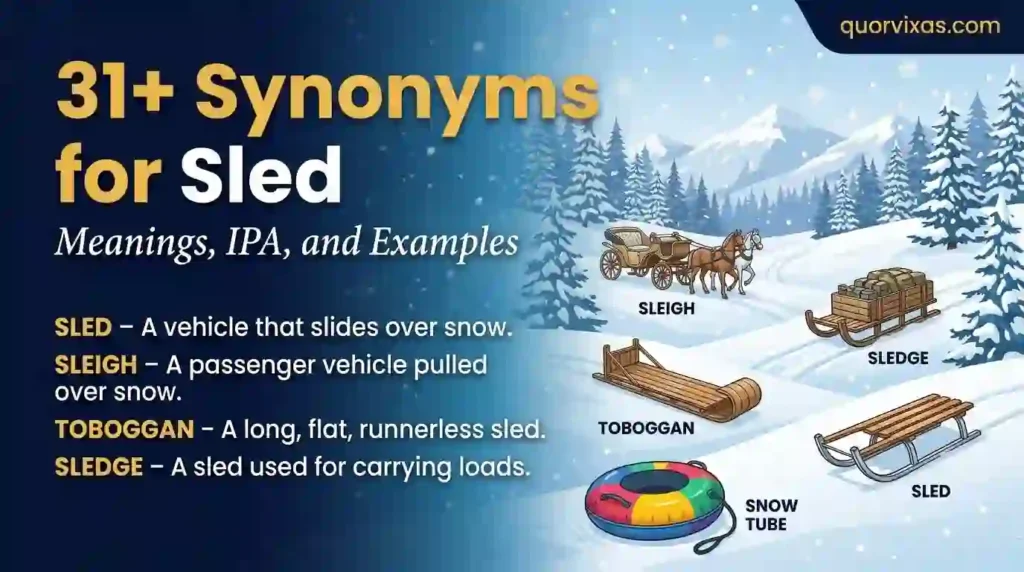
The closest everyday alternatives to sled are sleigh, sledge, and toboggan. In American English, a sled is usually a small vehicle for runners to slide over snow or ice.
Which alternative fits best depends on meaning and context: some words describe passenger vehicles, some describe sports equipment, and others describe tools for hauling loads.
The best word also depends on who rides, who pulls, and what the sled does. A child’s winter toy, an Olympic racing sled, and a farm tool for moving stones are all sleds, but each has its own name.
Quick list: sleigh, sledge, toboggan, dogsled, luge, bobsled, skeleton, cutter, travois, snow tube
This article covers 31 alternatives with meanings, IPA, usage notes, examples, and context. Some are direct synonyms, and others are related terms for specific situations.
At a Glance: Sled Synonyms and Related Alternatives
| Alternative | Part of Speech | Meaning | Register / Tone | Ideal Context |
| Sleigh | Noun | Passenger vehicle on runners, often horse-drawn | Neutral, traditional | Winter travel, holidays |
| Sledge | Noun | Sled, especially for loads (British) | Neutral, mostly British | Hauling, polar travel |
| Toboggan | Noun | Long, flat, runnerless sled | Neutral | Group sliding downhill |
| Dogsled | Noun | Sled pulled by dogs | Neutral | Arctic travel, racing |
| Luge | Noun | Small racing sled ridden feet first | Technical | Winter sports |
| Bobsled | Noun | Steerable team racing sled | Neutral, technical | Olympic racing |
| Cutter | Noun | Light one-horse sleigh | Dated, regional | Historical writing |
| Travois | Noun | Drag frame pulled by a person or animal | Specialized | Historical, cultural |
| Snow tube | Noun | Inflatable ring for sliding | Informal | Family recreation |
| Slide | Verb | Move smoothly over a surface | Neutral | Describing the action |
Which Word Should You Use?
| If you want to… | Use | Why |
| Name a child’s winter toy in the US | Sled | It is the ordinary American word. |
| Describe a horse-drawn passenger vehicle | Sleigh | It suggests seats and travelers. |
| Write British English for a loaded sled | Sledge | British usage favors it, especially for expeditions. |
| Describe a long, flat sled for several riders | Toboggan | It has no runners and a curled front. |
| Describe an Olympic sled | Luge, skeleton, or bobsled | Each names a distinct sport. |
| Describe a sled pulled by dogs | Dogsled | It names the power source. |
| Name a farm tool for moving heavy loads | Stoneboat or drag | These suits work, not play. |
| Describe the action of riding down a hill | Slide, coast, or glide | They work as verbs where “sled” is too narrow. |
Exploring the Multiple Meanings of “Sled”
1. A Vehicle on Runners
- Meaning: A vehicle with runners for traveling over snow or ice.
- Explanation: This is the broadest noun sense. It covers sleighs, dogsleds, and other vehicles built for winter travel.
- Example: The mail arrived by sled in the deep winter.
2. A Recreational Sled
- Meaning: A small sled used for sliding downhill for fun.
- Explanation: In everyday American English, this is the most common sense. It usually means a child’s toy.
- Example: The kids dragged their sled up the hill again.
3. A Hauling Sled
- Meaning: A low, runnered or flat frame for moving heavy loads.
- Explanation: Farmers, loggers, and explorers have used these sleds. Words like sledge, stoneboat, and drag often fit here.
- Example: He loaded the firewood onto a sled and pulled it to the barn.
4. A Sports Sled
- Meaning: A specialized sled built for racing.
- Explanation: This sense covers luge, skeleton, and bobsled, which differ in design and riding position.
- Example: The athlete trained for years on a racing sled.
5. To Travel or Play by Sled (verb)
- Meaning: To ride or transport something on a sled.
- Explanation: As a verb, sled means to go sledding or carry something by sled. The form sledding is common in everyday speech.
- Example: They sledded down the slope until dark.
Analyzing 31 Sled Alternatives in Detail
Some of these alternatives are direct synonyms for sled, while others are related terms for specific contexts. Each entry says which kind it is.
Core Everyday Synonyms
1. Sleigh
IPA: /sleɪ/ (US and UK)
Definition: A light vehicle on runners, usually drawn by horses, used on snow or ice.
- Usage: Close synonym for a passenger or festive sled. It suggests a seat and a driver, not a toy.
- Example: We took a sleigh ride through the snowy woods.
2. Sledge
IPA: /slɛdʒ/ (US and UK)
Definition: A vehicle on runners for carrying loads or people over snow, ice, or rough ground.
- Usage: Direct synonym, especially in British English, where it can also mean a children’s sled. In American usage it often sounds heavier or more work-related.
- Example: The explorers pulled the sledge across the ice.
3. Toboggan
IPA: US /təˈbɑːɡən/ · UK /təˈbɒɡən/
Definition: A long, narrow, flat sled without runners, with a curved front.
- Usage: Close related alternative. Most dictionary definitions stress the lack of runners.
- Example: Four friends squeezed onto one toboggan.
4. Dogsled
IPA: US /ˈdɔːɡˌslɛd/ · UK /ˈdɒɡslɛd/
Definition: A sled pulled by one or more dogs.
- Usage: Specific type of sled, named for how it is powered. It is not a general synonym.
- Example: The musher steered the dogsled across the frozen lake.
Sports Sleds
5. Luge
IPA: /luːʒ/ (US and UK)
Definition: A small racing sled ridden lying on the back, feet first.
- Usage: Related, sport-specific term. It names both the sled and the sport.
- Example: The luge reached high speeds on the ice track.
6. Bobsled
IPA: US /ˈbɑːbˌslɛd/ · UK /ˈbɒbslɛd/
Definition: A long racing sled with steering and brakes, ridden by a team.
- Usage: Related sport term. It is larger and more complex than an ordinary sled.
- Example: The team pushed the bobsled hard at the start.
7. Bobsleigh
IPA: US /ˈbɑːbˌsleɪ/ · UK /ˈbɒbsleɪ/
Definition: The British and international spelling of bobsled.
- Usage: Same sled as bobsled. It is the common form in international sports coverage.
- Example: Britain entered a two-man bobsleigh team.
8. Skeleton
IPA: /ˈskɛlɪtən/ (US and UK)
Definition: A racing sled ridden face down, head first, on a frozen track.
- Usage: Related sport term only. Outside winter sports, skeleton has an unrelated meaning.
- Example: She won a medal in skeleton.
9. Bob
IPA: US /bɑːb/ · UK /bɒb/
Definition: Short for bobsled.
- Usage: Informal, specialist shorthand. It is rarely used alone outside sports talk.
- Example: The bob flew around the final curve.
Recreational Snow Toys
10. Snow tube
IPA: US /ˈsnoʊ ˌtuːb/ · UK /ˈsnəʊ tjuːb/
Definition: An inflatable ring ridden down snowy slopes.
- Usage: Related, informal term. It slides like a sled but has no frame or runners.
- Example: The snow tube spun as it slid down the hill.
11. Snow saucer
IPA: US /ˈsnoʊ ˌsɔːsər/ · UK /ˈsnəʊ ˌsɔːsə/
Definition: A round, shallow plastic sled with handles.
- Usage: Related recreational term. It is a play item, and it spins easily.
- Example: He rode a snow saucer down the hill.
12. Kicksled
IPA: /ˈkɪkslɛd/ (US and UK)
Definition: A chair-like sled on runners that a rider pushes with one foot.
- Usage: Related type with a seat, standing runners, and a foot-push action. It is not a downhill sled.
- Example: She pushed her kicks along the frozen path.
13. Flexible Flyer
IPA: US /ˈflɛksəbəl ˈflaɪər/ · UK /ˈfleksəbəl ˈflaɪə/
Definition: A trademarked brand of steerable runner sled.
- Usage: Brand name, not a synonym. People sometimes use it generically, but it should stay capitalized.
- Example: Grandpa still had his old Flexible Flyer in the garage.
Horse-Drawn, Polar, and Travel Vehicles
14. Cutter
IPA: US /ˈkʌtər/ · UK /ˈkʌtə/
Definition: A light, small, usually one-horse sleigh.
- Usage: Related, dated term mainly in historical contexts.
- Example: The doctor arrived in a cutter.
15. Pung
IPA: /pʌŋ/ (US and UK)
Definition: A one-horse box sleigh, chiefly in New England.
- Usage: Regional and historical. Use it only for the specific vehicle.
- Example: They loaded the pung with supplies.
16. Troika
IPA: /ˈtrɔɪkə/ (US and UK)
Definition: A Russian vehicle drawn by three horses abreast, often a sleigh in winter.
- Usage: Related cultural term. It is not a general synonym for sled.
- Example: The troika raced across the snowy plain.
17. Carriole
IPA: US /ˈkɛriˌoʊl/ · UK /ˈkæriəʊl/
Definition: A small open carriage, also used for a light sleigh in some regions.
- Usage: Rare and historical. Its sled sense is regional, so check a full dictionary before using it.
- Example: The carriole glided over the frozen road.
18. Pulk
IPA: /pʊlk/ (US and UK)
Definition: A small sled pulled by a skier, or by a reindeer in Lapland.
- Usage: Related regional term, mostly in outdoor and Nordic contexts.
- Example: He packed the pulk before the ski trip.
19. Komatik
IPA: US /ˈkoʊməˌtɪk/ · UK /ˈkəʊmətɪk/
Definition: An Inuit sled with wooden runners, usually pulled by dogs.
- Usage: Culturally specific. The Inuktitut spelling qamutik is increasingly preferred.
- Example: The family traveled by komatik.
20. Snowmobile
IPA: US /ˈsnoʊmoʊˌbiːl/ · UK /ˈsnəʊməbiːl/
Definition: A motor vehicle for snow, driven on tracks and skis.
- Usage: Not a synonym. It replaced dogsleds in many places, but it is motorized.
- Example: He crossed the lake by snowmobile.
21. Snow machine
IPA: US /ˈsnoʊ məˌʃiːn/ · UK /ˈsnəʊ məˌʃiːn/
Definition: A regional name for a snowmobile, especially in Alaska.
- Usage: Regional and informal. It is also related only loosely to sleds.
- Example: They traveled by snow machine to the village.
22. Iceboat
IPA: US /ˈaɪsboʊt/ · UK /ˈaɪsbəʊt/
Definition: A sail-driven frame on runners for gliding over ice.
- Usage: Related only by its runners. It is a sailing craft, not a sled.
- Example: The iceboat raced across the frozen bay.
Hauling Sleds
23. Travois
IPA: /trəˈvɔɪ/ (US and UK)
Definition: A frame of two poles dragged by a person or animal to carry loads.
- Usage: Specialized, historical term. It is most often used for Plains peoples, and it is not a snow vehicle.
- Example: The camp’s belongings were carried on a travois.
24. Stoneboat
IPA: US /ˈstoʊnˌboʊt/ · UK /ˈstəʊnbəʊt/
Definition: A flat sled drawn by animals to haul stones or heavy loads.
- Usage: Related farm term, mainly North American.
- Example: The farmer cleared the field with a stoneboat.
25. Skid
IPA: /skɪd/ (US and UK)
Definition: A runner or frame for sliding heavy loads, such as logs.
- Usage: Related work term. It describes the sliding platform, not a passenger sled.
- Example: The logs were dragged on a skid.
26. Drag
IPA: /dræɡ/ (US and UK)
Definition: A sledlike frame pulled along the ground to carry heavy loads.
- Usage: Related, agricultural and dated. It usually works without runners.
- Example: They moved the boulder on a drag.
27. Dray
IPA: /dreɪ/ (US and UK)
Definition: A low, strong cart for heavy loads.
- Usage: Loosely related. Its sled sense is dialectal, and today it usually means a wheeled cart.
- Example: The brewery’s dray was pulled by horses.
28. Slipe
IPA: /slaɪp/ (US and UK)
Definition: A sled or skid in some dialects.
- Usage: Rare, regional, and mostly historical. Use only when imitating dialect.
- Example: The load slid along on the old slope.
Verb Alternatives
29. Slide
IPA: /slaɪd/ (US and UK)
Definition: To move smoothly over a surface.
- Usage: General action verb. It describes the motion, not the equipment.
- Example: The children slid down the snowy hill.
30. Coast
IPA: US /koʊst/ · UK /kəʊst/
Definition: To move downhill under gravity without effort.
- Usage: Related verb. It stresses effortless motion, and it is not exclusive to sleds.
- Example: We coasted to the bottom of the slope.
31. Glide
IPA: /glaɪd/ (US and UK)
Definition: To move smoothly and quietly.
- Usage: Related verb. It suggests smooth, graceful motion more than speed.
- Example: The sled glided over fresh snow.
Sled vs. Sledge vs. Sleigh vs. Toboggan
| Word | Typical Meaning | Runners? | Typical Use |
| Sled | General term, especially US | Usually | Play, light hauling |
| Sledge | British term or heavy load sled | Usually | Expeditions, work |
| Sleigh | Passenger sled, often horse-drawn | Yes | Travel, festive scenes |
| Toboggan | Long flat sled | No | Group sliding |
In American English, sled is the everyday word for a child’s slide. British English often uses sledge for the same toy. Sleigh adds a sense of seating and travel. Toboggan is the one to choose when the sled has no runners.
Sled and Opposite/Paired Word Pairs
| Word | Paired Word | Note |
| Sled | Wagon | Runners suit snow; wheels suit dry ground. |
| Sled | Sleigh | Sleigh is the passenger-style relative. |
| Sled | Ski | Both glide on snow, but a ski attaches to the foot. |
| Luge | Skeleton | Feet first versus head first. |
| Toboggan | Bobsled | Simple flat sled versus steerable team sled. |
Sled has no true antonym. The pairs above show contrasts and relationships rather than opposites.
Common Word Partners of “Sled”
| Pattern | Common Partners | Example |
| Adjective + sled | wooden, plastic, rocket | He built a wooden sled. |
| Verb + sled | ride, pull, drag | She pulled the sled uphill. |
| Sled + noun | dog, hill, race, run | The sled dog waited at the gate. |
| Preposition + sled | on a sled, by sled | Supplies came by sled. |
Idiomatic Phrases Featuring “Sled”
Sled has few true idioms. The first two below are genuine figurative expressions built on sledding. The third is an established compound, and it is literal.
1. Hard Sledding
- Meaning: Slow, difficult progress. Tough sledding is a common variant.
- Example: Writing the final chapter was hard sledding.
2. Easy Sledding
- Meaning: Smooth, easy progress. It is the informal opposite of hard sledding.
- Example: After the first week, it was easy sledding.
3. Sled Dog
- Meaning: A dog trained to pull a sled. This is a literal compound.
- Example: The sled dog pulled eagerly at the harness.
Word Formation of “Sled”
Etymology & Structure
Sled is a short, one-syllable noun. It comes from Middle English sledde, which traces to Middle Dutch. It is related to the verb slide. Sledge and sleigh also trace to Dutch, which is why the three words look alike.
Date and History
Merriam-Webster dates sled to the 14th century. Sleigh appears later in American English, around the early 18th century, according to Etymonline.
Word Class Variations
- Noun: sled
- Verb: sled, sleds, sledded, sledding
- Noun (activity): sledding
- Noun (person): sledder
Common Word-Choice Mistakes
- Sledgehammer has no connection to sleds: its sledge comes from an Old English word meaning “to strike.”
- Using toboggan for any runner sled: toboggans have no runners.
- Calling a snowmobile a sled: a snowmobile is motorized.
- Treating luge and skeleton as the same: luge is feet first, skeleton is head first.
- Writing “bobsled” for any racing sled: it means the team sled.
- Using sleigh for a child’s toy in American English: sled is the usual word.
- Using slide as a noun for a sled: the noun slide names the playground structure.
Frequently Asked Questions
What is the closest synonym for sled?
Sledge and sleigh are the closest, although sleigh usually suggests a passenger vehicle.
What is another word for a child’s sled?
In British English, sledge is common. In American English, sled is standard, and toboggan or snow saucer may describe a particular type.
What is the difference between a sled and a sleigh?
A sleigh usually carries people and is often pulled by horses. A sled is more general and often smaller.
What is the difference between a sled and a toboggan?
A toboggan is long, flat, and has no runners. A sled usually has runners.
What is a formal alternative to sled?
Sledge is the standard formal choice, especially in British English.
Is a snowmobile a type of sled?
No. It is a motor vehicle, though it is related to sled travel.
What sled do Olympic athletes use?
It depends on the sport: luge, skeleton, or bobsled.
Can sled be a verb?
Yes. Sled means to ride or carry something on a sled, and sledding is the common form.
What is a sled pulled by dogs called?
A dogsled, or in Inuit contexts a komatik or qamutik.
Is there an opposite of sled?
No true antonym exists. A wheeled cart such as a wagon is its natural contrast.
Conclusion
The closest alternatives to sled are sleigh, sledge, and toboggan. Each has its own focus: passengers, loads, or runnerless sliding. Sport terms like luge, skeleton, and bobsled name specific racing sleds.
Context decides the best word. Ask if the sled carries people or goods, who or what pulls it, and if it is a toy, a work tool, or an athletic sled. Dialect also matters, because sledge and sled split along British and American lines.
When in doubt, use sled for everyday American English and sleigh for a passenger vehicle. Use sledge in British English and for heavy loads. Choose a specific name like toboggan, luge, or dogsled only when the details matter.

Hi, I’m Alex Morgan! I love exploring words and discovering new ways to express ideas. Through Quorvixas.com, I’m here to help you find the right synonyms, expand your vocabulary, and make writing feel easier, more natural, and enjoyable.